120 years ago today: The story of Anfield's famous Spion Kop begins
On this day 120 years ago, Liverpool FC first played in front of what is now known as the Spion Kop. Here, matchday programme writer Will Hughes tells the story of how Anfield’s famous stand came into being…
If you had taken a look around Anfield during Liverpool’s title-winning season of 1905-06, there was nothing remarkable about the Reds’ home of a little over a decade.
Like most football grounds of the day, it was largely made up of earth with irregular timber crush barriers dotted about. Basic iron and timber flat roofs covered wooden bench seats and there was no complete outer wall to enclose the ground and offer much in the way of security.
The chimneys of the Stanley House residence of founding father John Houlding could be clearly seen from opposite the Anfield Road end, jutting out over the modestly covered terrace.
For the first time since Liverpool’s formation in 1892, average attendances (17,736) surpassed those of Everton’s (15,920).
However, author and historian John Williams, in his excellent history of the club Redmen, points out that gate receipts at Goodison Park remained higher.
It felt like Liverpool deserved a more fitting home and the board of directors agreed, announcing an ambitious remodelling of the stadium that would take place in the three months between the season’s end and the start of the 1906-07 campaign.
Overseeing the work was the brilliant young Scottish engineer Archibald Leitch, a revolutionary figure in stadium design, who had embraced new advances in technology and materials to build bigger and safer stands at British football grounds.
Having worked with both Everton and now Liverpool to redesign both grounds, he even set up his family home in Blundellsands to the north of the city in 1909.
This was arguably the largest stadium project ever taken on by the club given that all but the Anfield Road end underwent renovation.
To complete the work in such a short timescale was a huge task and it proved a lot more onerous than expected. However, during that summer of 1906 everybody chipped in. Even manager Tom Watson and the club’s directors mucked in and got their hands dirty, and there was great pride in what was taking shape.
As the 1906-07 season approached, there was much excitement around the ‘new Anfield’.
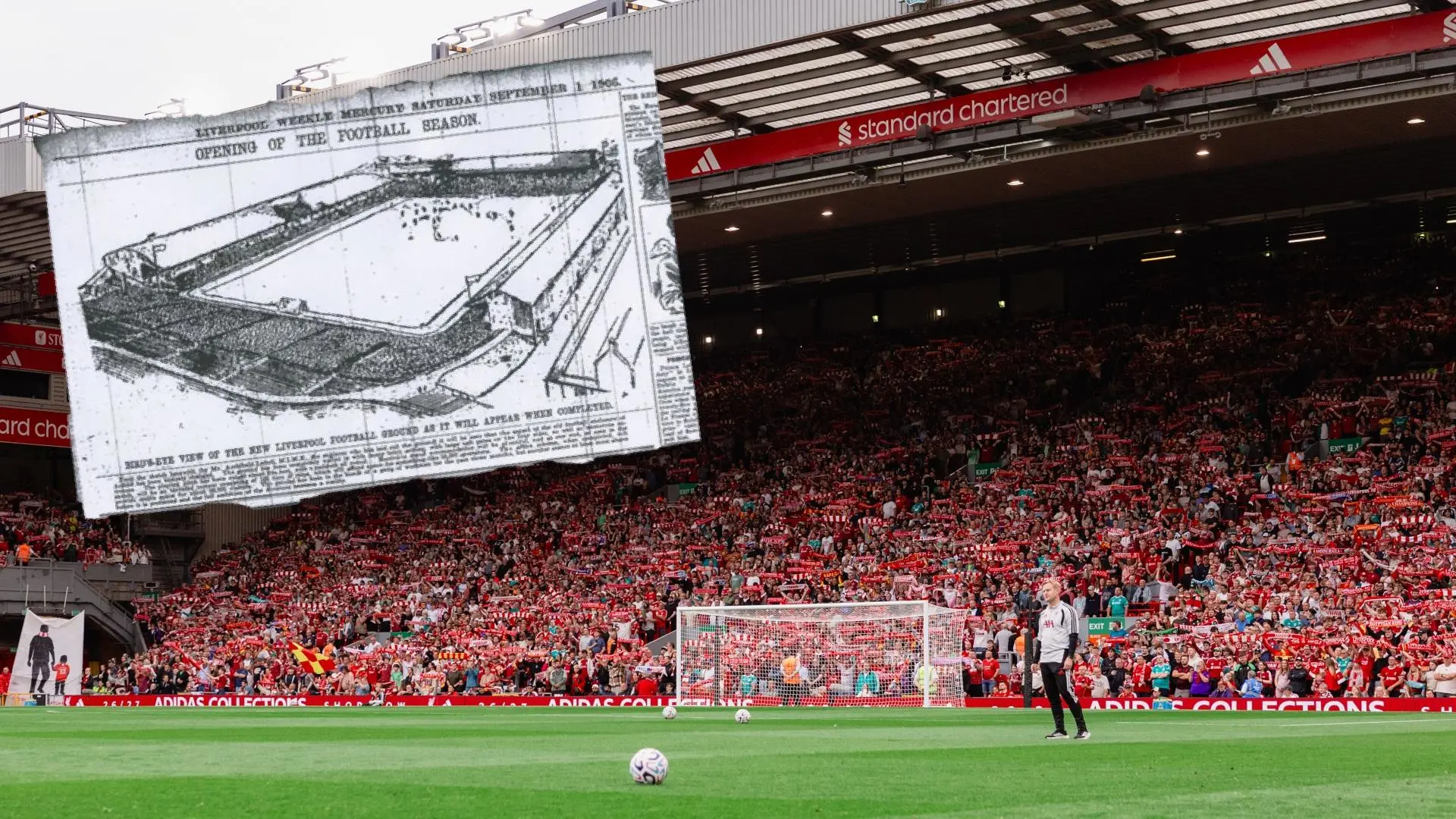
Before the opening home game against Stoke City on September 1, selected journalists were invited to take a sneak preview and the Liverpool Echo commented that the entire scheme was ‘modelled on a new departure from what football grounds are generally supposed to be’.
In an article titled ‘Liverpool Football Club. The Improved Ground’, which appeared on August 25, 1906, the Echo reported: “Having made up their minds to effect a much-needed transformation, Mr Edwin Berry CC and his colleagues decided to spare no reasonable expense in making the Liverpool ground one of the very best in the country.
“That they have succeeded will, we think, be admitted by ‘the Anfield crowd’ when the opening of the 1906-07 campaign provides them with the opportunity of inspecting the improvements for themselves.”
Anfield was now completely walled in and its ‘fancy brick settings’ gave it a striking new look from the outside.
The number of turnstiles rose from 26 to 47 and large exit gates were put in place on all four sides of the ground.
The pitch was raised by 1.5 metres and slightly repositioned, while the corners of the ground were rounded to avoid wasting any space. And a narrow paddock ensured that all four stands were now joined, allowing supporters on the terraces to switch ends depending on which way Liverpool were attacking.
The old Main Stand was carefully dismantled and rebuilt on the opposite side to replace the structure on the Kemlyn Road. In its place a new grandstand was erected. When fully completed the following season, it became the first football stand to be made using reinforced concrete by a method known as the ‘Hennebique system’.
Its iron-framed barrel roof also featured a distinctive red and white mock Tudor-style arched gable in the centre (although the words ‘Liverpool Football Club’ were added later).
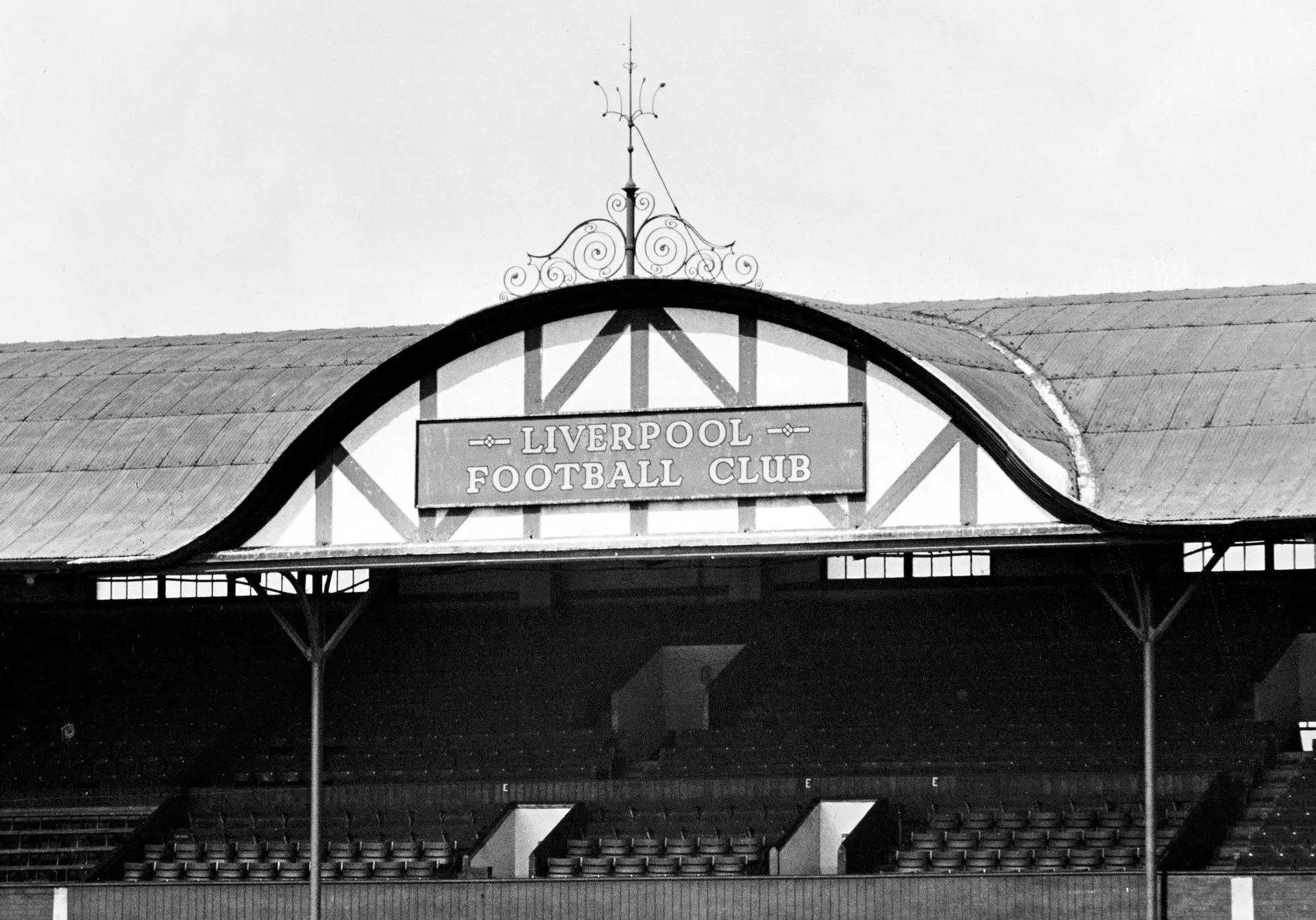
This was a trademark of Leitch’s designs and would come to symbolise the ground for more than 60 years until the stand underwent further redevelopment in 1970.
What was to become more famous, though, was the elevated terrace to its right. Now extended and consisting of 132 tiered steps, it towered over the rest of the ground and could accommodate up to 20,000 spectators.
It would soon become universally known as the Spion Kop, after a hill now located in modern-day South Africa, which was the scene of a significant battle during the Boer War six years earlier during which many soldiers from Liverpool were killed.
Local lore has always maintained that Anfield’s large open terrace was christened the Spion Kop by Ernest ‘Bee’ Edwards, then sports editor of the Liverpool Echo.
However, no evidence has ever emerged to support this claim.
The more credible explanation is that it was the supporters, many of whom had fought in the war, who first referred to it as such.
We do know that Bee picked up on this and encouraged further use of this description because he later wrote in his newspaper column: “This huge wall of earth has been termed Spion Kop and no doubt this apt name will always be used in future in referring to this spot.”
It seems quite a stretch to assume that all supporters immediately started calling it by that name and only after 1912 was it consistently referenced in press reports as the Kop.
At which point the club adopted the name is also open to conjecture, there being no tangible proof of the term being used officially until a later redevelopment in 1928 – including the addition of a roof first suggested in the 1906 plans – under the watch of a different architect, Joseph Watson Cabre.
Liverpool’s ‘new’ Anfield stadium was one of the best equipped in England when it was unveiled to the public on September 1, 1906.
A crowd of 30,000 packed onto the new terrace. They witnessed the defending champions defeat Stoke 1-0 thanks to a 20th-minute goal from forward Joe Hewitt.
The Chester-born attacker became the first man to score in front of the Kop as, back then, captain Alex Raisbeck opted to kick towards the massed ranks of Reds supporters in the first half.
In the years since, the Spion Kop has become one of the largest, most passionate and feared single-tier stands in football.
Mention of the name inspires images of colour, humour, passion and spine-tingling excitement, with Liverpool supporters proudly singing: ‘We are the famous, the famous Kopites!’