

NewsLiverpool's Greatest - No.11: Billy Liddell
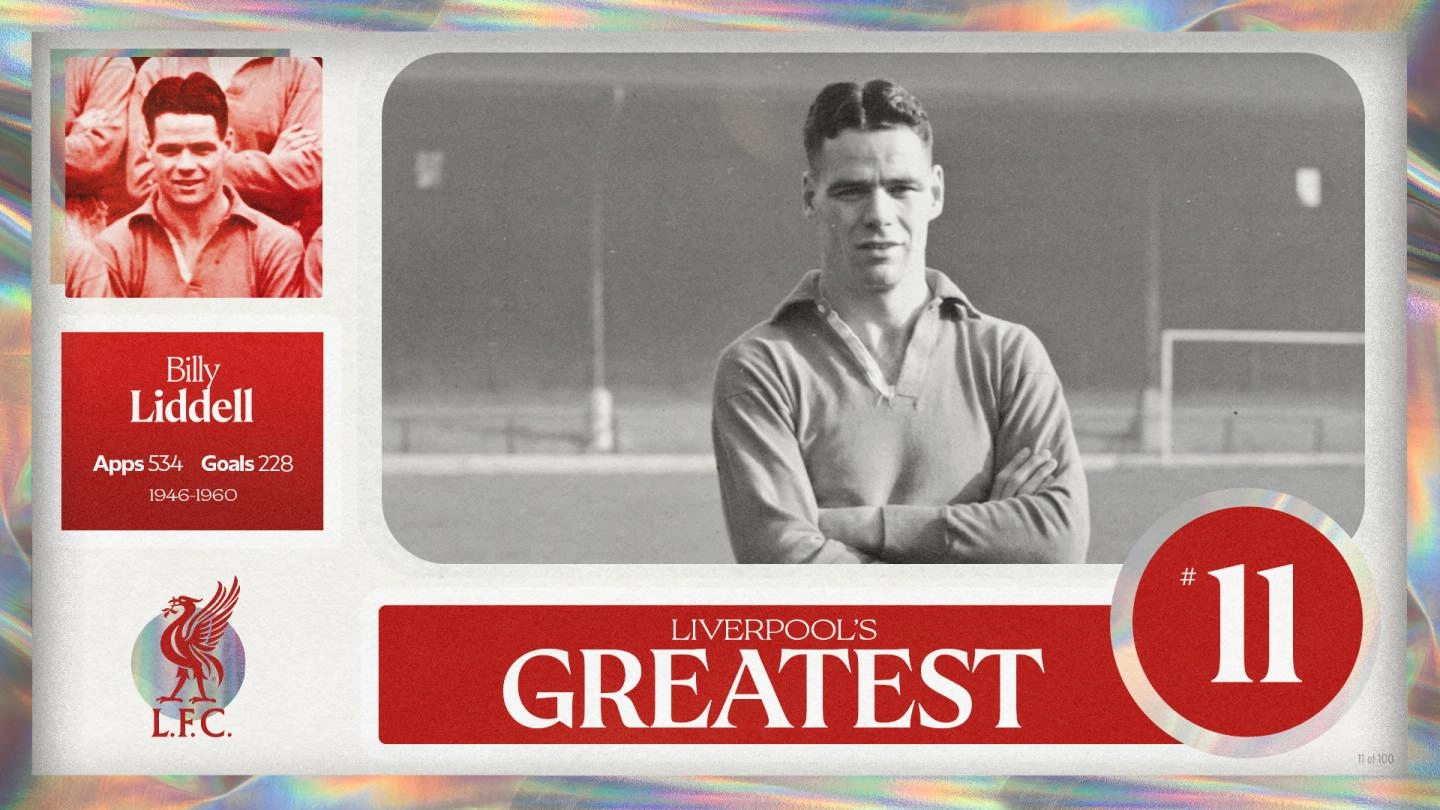


Years: 1946-1960
Appearances: 534
Goals: 228
Trophies: First Division (1946-47)
Billy Liddell was such a star for Liverpool that the club itself was nicknamed after him during his era.
The Scot joined the Reds in 1938 and turned professional a year later, but the onset of World War II meant he would not be able to put the shirt on competitively until January 1946.
In a sign of things to come, he marked his belated debut with a goal in an FA Cup tie at Chester, followed by two strikes on his First Division bow.
His maiden league campaign could not have gone better, Liddell providing 18 goal contributions as the championship was won by George Kay’s team.
Soon after, he supplied goals in the quarter-final and semi-final to send Liverpool to the 1950 FA Cup final, where a 2-0 defeat by Arsenal – on a day when their talisman was kicked out of the game – denied them the trophy at Wembley.
Superlative in his technical attributes, swift on his feet and an inspirational force for those around him, he also boasted a blistering finish from long range.
Typically deployed on the left wing, Liddell later switched to a more central attacking role, but featured in practically every position apart from goalkeeper in 500-plus appearances across a 14-year spell.
While footage of Liddell’s abilities is limited, those who witnessed him on the pitch speak of him in the most reverent tones, bestowing a status equal to the likes of Kenny Dalglish and Steven Gerrard.
Teammate Albert Stubbins described him as ‘invaluable to Liverpool’, saying: “He’d beat fellas with speed, direct running at the full-back so they didn’t know which way Billy would go. Would he go left or right? He was so fast, he could pick up speed quickly.
“And he was very courageous. Also, he had a deadly shot in both feet – it didn’t matter which one, Billy could hit the ball. He was a great player.”
Liverpool’s record appearance-maker, Ian Callaghan, saw Liddell in action and said: “He was so strong and he went past people and he had this fantastic ability to cross the ball – and they were heavy balls in those days – but he could cross it from anywhere.
“Then if he had a shot from 30 yards, it was ‘vroom…’ It was just amazing, it really was.”
Liddell reached double figures for goals in 10 different campaigns, rising to 32 as his highest haul, and totalled 228 – a figure only four men in Reds history can better.
Collectively, though, Liverpool were unable to build on that 1946-47 title victory or the subsequent FA Cup final appearance, and after suffering relegation in 1953-54 they languished in the Second Division for eight years.
Liddell’s individual brilliance and unflinching loyalty – he rejected multiple, often lucrative opportunities to leave Anfield – were therefore not translated into further honours.
His reward instead was idolisation. ‘Give it to Billy,’ supporters would roar. And the club became known as ‘Liddellpool’.
“I think there’s a lot of comparisons with Gerrard in the fact that when Gerrard was playing he was above the level of the team and Billy certainly was as well,” said Peter Kenny Jones, football historian and author of 2022 book Liddell at One Hundred: A Family Portrait of a Liverpool Icon.
“So as a figurehead who would score the last-minute winner and pick the team up by the scruff of the neck and get the win, I think that’s what he did really and that was his level.”
Liddell was still playing when Bill Shankly became Liverpool manager and his final match for the club, in August 1960, came more than two decades after he arrived on Merseyside.
Get exclusive early access to the next players revealed on the Liverpool's Greatest list every day on the official LFC app: iOS | Google Play