

Mighty Red plush
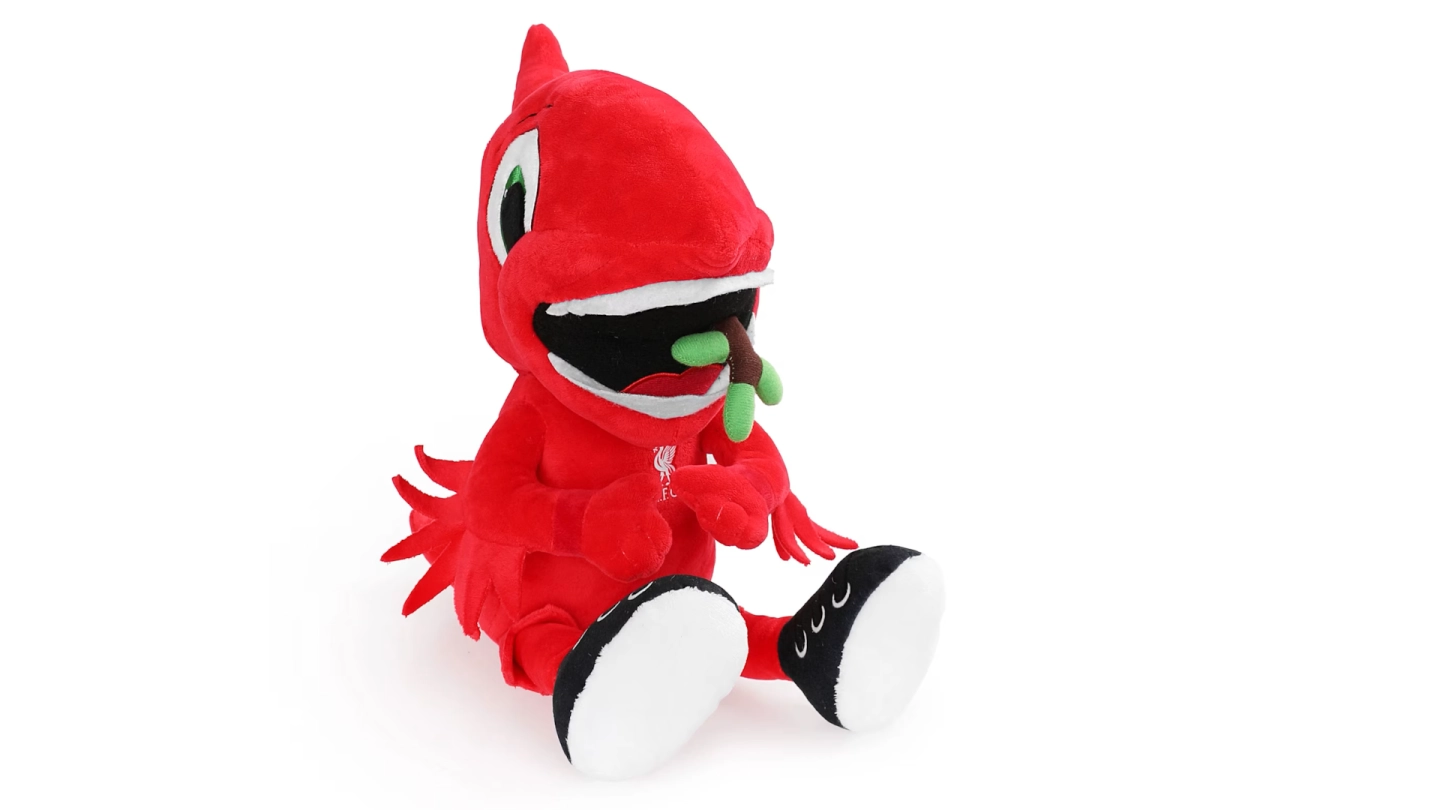
1.30kg CO2e total footprint
The table below displays the calculated 'cradle-to-retail' carbon footprint of one recycled polyester Mighty Red plush toy, delivered to the applicable Liverpool FC store.
Figure shown is representative for a product delivered to an LFC retail store.
Where the emissions come from
Additional details
LFC commissioned a Life Cycle Assessment (LCA) for the Mighty Red plush toy, conducted in accordance with ISO 14067:2018, ISO 14040/44 and the GHG Protocol Product Life Cycle Accounting and Reporting Standard, to estimate the Product Carbon Footprint (PCF) of the toy.
The Mighty Red plush toy is made almost entirely from recycled polyester, produced from post-consumer plastic bottles that are collected, cleaned, and reprocessed into fibre and fabric. The toy is manufactured at an LFC supplier's production site in Lianyungang, China, and shipped by sea to either the club's UK or Netherlands distribution centres. The products shipped to the UK distribution centre are then sent by road transport to the applicable Liverpool FC retail store.
The main manufacturing steps are fabric cutting, embroidery, sewing, fibre stuffing, finishing, and packing; the toy involves no dyeing, as all materials arrive pre-coloured.
The primary data collected for the study covers raw-material quantities, site energy and water use, manufacturing waste, and inbound and outbound transport. The footprint was calculated from the actual production batch manufactured in February 2026: 4,500 Mighty Red toys. Each Mighty Red weighs approximately 253g. On a volume-weighted average across the batch, the estimated carbon footprint is 1.30kg CO2e for one Mighty Red.
Contribution analysis
Raw materials: The largest source of the toy's carbon footprint is the recycled polyester it is made which includes the fabric, the plush pile, and especially the fibre filling. This raw-material stage accounts for 60.77% of the total. Recycled polyester still carries a real production burden because used bottles must be collected, cleaned, melted, and spun into new fibre.
Manufacturing: Making the toy at the factory including the electricity and water used for cutting, embroidery, sewing, and stuffing, is the next largest source, at 14.62% of the total. The site draws grid electricity from the Chinese national grid; there is no dyeing or gas-fired process, as all materials arrive pre-coloured, so this figure comes almost entirely from electricity use.
Packaging: The recycled-paperboard transit carton and the paper swing tag together account for 6.92% of the total.
Transport and distribution: All freight combined which includes moving raw materials to the factory, shipping the finished toy from China by sea, and the final road and van delivery to LFC's UK and Netherlands distribution centres and stores make up 17.69% of the total. The sea crossing is the largest single freight line, though the shorter road and van legs within the UK yield the greater carbon contribution. The allocation of the UK units among the applicable LFC retail stores will be based on consumer demand and is not currently known. All UK store-destined units are therefore modelled on the most carbon-intensive store route, being van delivery from the UK distribution centre to the London Oxford Street store, 203 miles (326.7 km).
How do third-parties support LFC?
Using primary data and documentation provided by LFC and its suppliers for the February 2026 production batch, the Product Carbon Footprint of the toy was modelled over a cradle-to-retail system boundary using the carbon-management software CarbonSig, which LFC uses to track its products' emissions, in accordance with:
- ISO 14067:2018; Greenhouse gases; Carbon footprint of products; Requirements and guidelines for quantification; and ISO 14040/44 and the GHG Protocol Product Life Cycle Accounting and Reporting Standard.
- No sector-specific Product Category Rules were applied; the toy is assessed as a standalone study to the standards above, with no comparative assertion made against any other product.
Bureau Veritas UK conducted an independent critical review, with limited assurance, via structured data sharing through the CarbonSig verification portal to confirm that the Product Carbon Footprint analysis of the toy conforms with ISO 14067:2018 for the cradle-to-retail life-cycle boundary.
CarbonSig was used to support the development of the life-cycle model for the toy over the cradle-to-retail system boundary and will substantiate the carbon credit assignment and provide serialized "carbon receipts" for the purchased items.
What is the process for carbon credit purchase and retirement?
LFC has contracted with 1PointFive to purchase carbon dioxide removal (CDR) credits to address the carbon footprint embedded within this plush toy. For more information on this purchase, please see our joint announcement.
The footprint is measured up to the point at which each toy is delivered through an LFC distribution centre or to the applicable LFC retail store (onward transport after sale is excluded).
Price
The LFC x 1PointFive Mighty Red plush toy retails at the same price point as other equivalent LFC plush toys — RRP £28. After making emissions reductions in the supply chain, purchasing credits to remove the equivalent quantity of estimated CO2 from the atmosphere will add less than £1 to the cost of manufacturing each toy, which is taken on by the club and not added to the final RRP.